 1-888-910-7366



Basement Renovation Toronto
The short version. We finish Toronto basements start to finish: moisture and drainage sorted first, then framing, electrical and plumbing rough-ins, inspections, insulation, drywall and finishes. One contractor is accountable for all of it, the price is agreed in writing before the work starts, and the workmanship carries a one year guarantee.
Basements are the hardest room in a Toronto house to get right. They involve several trades, they often reveal conditions nobody can see until the floor is opened, and in older homes the head height, the drains and the wiring all need decisions before a single wall goes up. That is exactly why a single accountable contractor matters more here than anywhere else in the house.
If you want the full order of operations before you talk to anyone, we wrote it out here: what is involved in a Toronto basement renovation, step by step.
Toronto Basements Are in a Category of Their Own
Toronto’s housing stock is old by North American standards. A large portion of the homes in East York, Leaside, the Beaches, and North York were built between the 1920s and the 1960s – and their basements reflect that era. Dirt floors are more common than most buyers expect. Concrete block foundation walls with no insulation. Low ceiling heights that make the space feel like a crawl space rather than a room. Exposed ductwork running through the middle of the space. Utilities – furnace, hot water tank, laundry – crammed into corners with no thought given to how the rest of the space might ever be used.
Then there’s the water. Toronto sits on a mix of soil types and has a water table that varies dramatically by neighbourhood. Some Leaside and East York properties deal with significant groundwater pressure, particularly in spring. A finished basement that wasn’t properly waterproofed is a future insurance claim waiting to happen.
We’ve worked in enough Toronto basements to know all of this before we open your door. That means we plan for it rather than discovering it halfway through your project.
What a HandyForce Basement Renovation Can Include
Every basement project is different. Some clients come to us with a raw, unfinished space and want it turned into a livable room. Others have a finished basement that’s dated, damp, or poorly laid out. Others need structural work – lowering, waterproofing, or underpinning – before any finishing can happen. We handle all of it.
Water is the number one enemy of a finished basement. Before we frame a single wall or lay a single floor, we assess whether your basement has a moisture problem – and if it does, we solve it first. There’s no point finishing a space that’s going to be damp in six months. We can handle the whole process from underpinning, to waterproofing to framing, electrical and plumbing, to drywalling and painting!
Services

Interior waterproofing
Interior waterproofing – our most common solution for Toronto homes – involves installing an interior drainage membrane along the base of the foundation walls, directing any water that does get in toward a sump pump rather than letting it pool on the floor. We install primary sump pumps and, for homes with higher water table risk, a battery-powered backup sump pump. If the power goes out during a heavy spring storm – exactly when you need the sump running – the backup keeps working.

Exterior waterproofing
Exterior waterproofing – is more comprehensive but also more invasive and expensive. It involves excavating around the foundation to apply a waterproof membrane to the outside of the wall. For some properties it’s the right call. For others – particularly older homes with mature trees and established gardens where excavation would cause significant damage – interior waterproofing is the smarter, more cost-effective solution. We’ll tell you honestly which approach makes sense for your home and why.

Basement Underpinning and Lowering
Many Toronto basement ceilings sit at 6 feet or less – technically usable, but not comfortable as a living space. Underpinning lowers the basement floor by excavating beneath the existing foundation footings and pouring new, deeper concrete. The result is a full-height ceiling and a space that actually feels like a room.
Underpinning is a structural process that requires engineering drawings and a building permit. We manage the permit application and work with structural engineers as needed. If your basement has a dirt floor, the process also includes lowering the grade, compacting the subbase, and pouring a proper concrete slab – the foundation (literally) on which everything else is built.

Basement Framing, Insulation, and Drywalling
Once the structural and waterproofing work is done, we frame the space – creating the room layout, separating living areas from utility areas, and building the bulkheads and soffits that enclose ductwork and pipes in a clean, finished way. Insulation goes into the walls and, where needed, under the floor. Drywall follows, taped, mudded, and sanded to a smooth finish.
We plan the utility separation carefully. Furnaces, hot water tanks, and laundry equipment need to remain accessible – but they don’t need to dominate the space. A well-designed utility room wall with a proper door gives you a clean living area on one side and full access to everything mechanical on the other.

Basement Flooring, Painting, and Finishing
A basement floor has different requirements than the rest of your home. It needs to handle moisture that may wick up through the concrete, temperature fluctuations, and the kind of hard use that a family room or rec room gets. We typically recommend luxury vinyl plank – it’s warm underfoot, water-resistant, durable, and looks genuinely good. For basements being finished as rental suites or home offices, other options are available depending on the use case.
Painting, trim, pot lights, and electrical outlets complete the space. We handle all of it – you’re not coordinating between an electrician, a painter, and a flooring contractor. One project manager, one contract, one fixed price.
How a HandyForce Basement Renovation Works

Step 1: The Quote Visit
A dedicated quoter visits your home, assesses the basement – its current condition, ceiling height, moisture signs, utilities layout – and builds a comprehensive day-by-day project plan using our proprietary software. The quote you receive is a fixed price tied to a specific scope. No vague estimates, no surprises.

Step 2: Share the Dream
Once you’re ready to move forward, your quoter and your dedicated project manager meet with you together. The full plan is walked through, questions are answered, and a contract is signed that locks in the scope and price. From this point, your project manager owns the project.

Step 3: Permits and Engineering (Where Required)
Structural work – underpinning, lowering, load-bearing changes – requires a building permit and in most cases an engineer’s sign-off. We handle the permit application and coordinate with engineers. You don’t need to navigate the City of Toronto’s permit process yourself.

Step 4: The Renovation
Your crew works on a pre-planned schedule. Materials are staged in advance. Trades are sequenced correctly – waterproofing before framing, framing before drywall, rough electrical before insulation. Your project manager is on-site every day and updates you by whatever method works best – text, email, phone, Zoom. If you’re travelling or at work, you won’t miss a thing.

Step 5: Final Walkthrough
At the end of the project, your project manager walks the finished space with you. Any deficiency is resolved immediately. The final balance isn’t due until you’re satisfied.
Real Project: A Leaside Dirt Basement Becomes a Family Room
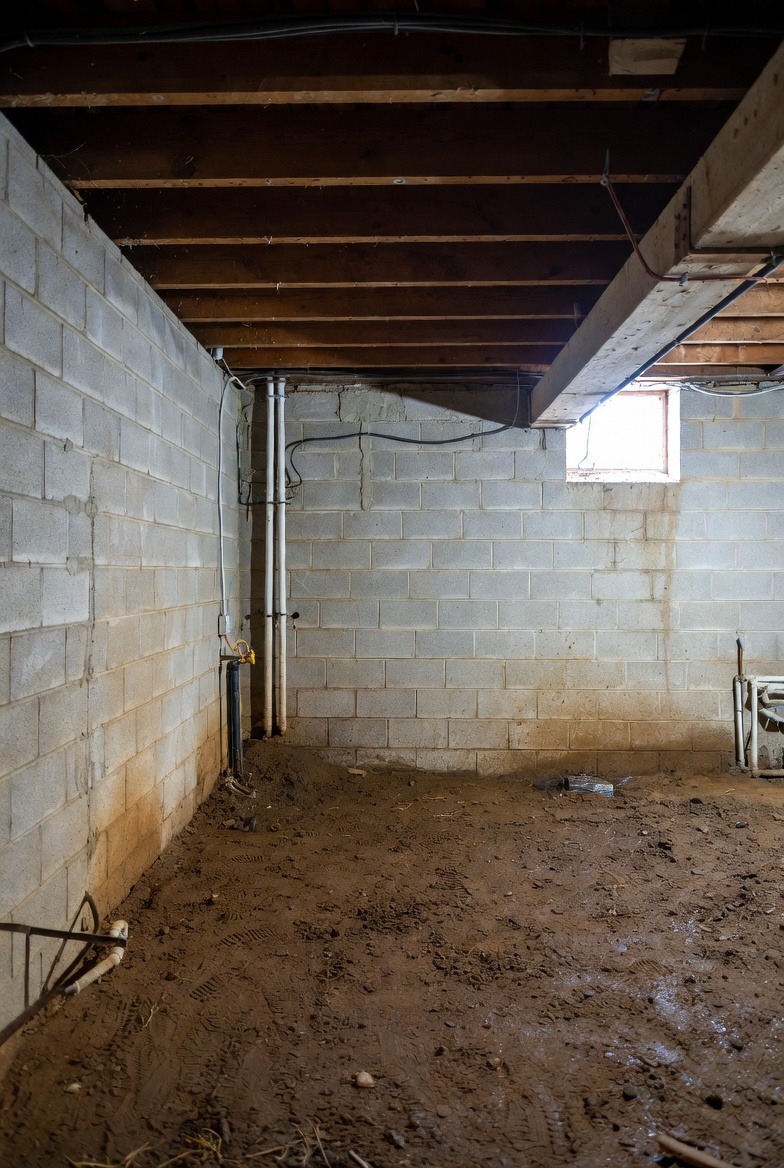
A family unfriendly space....
The family had recently adopted a son, and between him and their daughter, they needed somewhere for the kids to be kids – to run around, leave toys on the floor, watch movies, and generally make the kind of joyful noise that’s hard to contain in a living room. The basement was the obvious answer. The problem was the basement.
It was a raw dirt floor, original to the house. Concrete block walls. Exposed joists overhead. A gas line running along one wall, ductwork cutting through the middle of the space. And sitting in Leaside, the property had a high water table – meaning any finishing work done without proper waterproofing would be damp within a season or two.
We started at the ground – literally. The dirt floor was excavated, graded, and compacted. A concrete slab was poured. Before a single stud went up, we addressed the water: an interior drainage membrane was installed along the base of the foundation walls, directing any groundwater to a new sump pump. Then we added a second, battery-powered backup sump. In a Toronto spring – when the ground is saturated and the power occasionally goes out during storms – that backup isn’t optional. It’s peace of mind.

To their little slice of heaven.
The ductwork that ran through the middle of the space was rerouted to the perimeter and enclosed in a bulkhead, freeing up the ceiling height in the main room. The gas line stayed in place. A new wall was framed on one side of the basement to enclose the utilities – furnace, hot water tank, laundry – giving the family a proper, accessible utility room and a clean, uninterrupted living space on the other side.
From there: insulation, drywall, pot lights, vinyl plank flooring in a light oak finish, grey painted walls, white baseboards. The whole space.
The finished room is bright, warm, and completely livable. It’s become exactly what they wanted – a family room in the truest sense. Movie nights, toy explosions, imaginary adventures. The kind of laughing that echoes off the walls. Same house. Completely different life in it.
What's Included in a HandyForce Basement Renovation Toronto
Depending on your basement’s starting point and your goals, work can include any combination of the following:
Structural and Waterproofing
- Dirt floor excavation, grading, compaction, and concrete slab pour
- Basement underpinning and lowering
- Interior drainage membrane installation
- Sump pump installation – primary and battery backup
- Exterior waterproofing (where appropriate)
- Engineering drawings and permit management
Framing and Mechanical
- Full basement framing and room layout
- Utility room separation and enclosure
- Ductwork rerouting and bulkhead construction
- Insulation – walls and subfloor
- Rough electrical – pot lights, outlets, circuits
- Plumbing rough-in (for basement bathrooms or wet bars)
Finishing
- Drywall installation, taping, and finishing
- Painting and trim
- Flooring – luxury vinyl plank, laminate, or tile
- Tile work (for basement bathrooms or wet areas)
- Pot light installation and finish electrical
- Egress window installation (for rental suites requiring natural light)
Not sure where your basement sits on this list? That’s exactly what the quote visit is for. Our quoter will assess the space honestly and tell you what’s needed, what’s optional, and what the right sequence is for your specific situation.
Our Guarantee: Fixed Price, Finished Basement, No Surprises
Basement renovations are one of the areas where Toronto homeowners most commonly get burned. A low quote gets the job, surprises appear once the floor comes up, and the cost doubles. We don’t work that way.
- Fixed-price guarantee – the number in your contract is the number you pay. Any change to scope is agreed in writing before it happens.
- You pay a 10% deposit, 40% on the first day of work on projects over $5,000, and the balance only after satisfactory completion.
- Our one-year workmanship guarantee covers all labour. If something isn’t right, you reach out and a service ticket is created immediately – our highest internal priority.
- 6-month follow-up on every project. We check in to confirm everything is still performing as it should – especially important for waterproofing work after the first winter and spring cycle.
- All our handymen are full-time employees. Licensed trades such as electrical and plumbing, and some specialist work on larger renovations, are done by licensed partners we manage.
Frequently Asked Questions

It depends heavily on scope. A straightforward finishing project – framing, drywall, flooring, painting – on an already-concrete basement typically takes 3 to 5 weeks. Projects that include underpinning, waterproofing, or a concrete slab pour add time for curing and, in the case of underpinning, permit approvals. Your quote will include a day-by-day schedule so you know exactly what to expect before we start.
It depends on what’s being done. Adding a bathroom, bedroom (for a rental suite), or doing structural work like underpinning always requires a permit. Basic finishing – framing, insulation, drywall, flooring – may not, depending on the scope. Our quoter will identify any permit requirements during the quote visit and we’ll handle the application and coordination with the City of Toronto.
Yes – this is something we do regularly in older Leaside, East York, and Toronto homes. The process involves excavating and lowering the grade if needed, compacting the subbase, and pouring a concrete slab. If water table is a concern, we address waterproofing before the slab goes in. The slab is the foundation for everything else – flooring, framing, and finishing all follow once it’s cured.
Both are valid approaches and the right choice depends on your property. Interior waterproofing – a drainage membrane along the base of the foundation walls directing water to a sump pump – is less invasive, more cost-effective, and works well for most Toronto homes. Exterior waterproofing is more thorough but requires excavating around the foundation, which can be disruptive and costly, especially for older properties with mature trees and established landscaping. We’ll assess your specific situation and recommend the approach that makes the most sense, not the most expensive one.
Yes, and it’s one of the more common requests we get – particularly in East York and North York where homeowners are looking to offset mortgage costs. A legal basement suite requires a building permit, a separate entrance, minimum ceiling height, egress windows in any bedroom, a smoke and CO alarm system, fireproofing, and in many cases a separate electrical panel. We handle all of it. If you’re considering a rental suite, mention it at the quote stage so we can plan the layout and permit requirements from the start.
Luxury vinyl plank is our most common recommendation for Toronto basements. It’s fully water-resistant, handles the temperature fluctuations that basements experience, is comfortable underfoot, and looks genuinely good in a finished space. It’s also more forgiving than hardwood if there’s ever minor moisture. For basement bathrooms or wet bar areas, porcelain tile is the right call. We’ll recommend what makes sense based on how you plan to use the space.
Basement Renovation Toronto: The Neighbourhoods We Serve
We serve homeowners across East York, North York, Leaside, the Beaches, Leslieville, Cabbagetown, and the surrounding Toronto neighbourhoods. Our office is at 1352C Woodbine Ave in East York – we’re a local team, not a franchise operation dispatching crews from the suburbs.
We know Toronto’s older housing stock well. We know which neighbourhoods tend to have water table issues, which foundation types are common in which eras of construction, and what a 1940s East York semi typically looks like once the floor comes up. That experience means fewer surprises – and when surprises do happen, a team that knows how to handle them.
Ready to Talk About Your Basement?
Whether you’re starting from a dirt floor or a dated 1990s finish, the first step is the same – a conversation. Tell us what you’ve got and what you want. Our quoter will take it from there.
Call us at 647-427-7366, reach us toll-free at 1-888-910-7366, or click Request a Quote. We’ll schedule your quote visit and build a plan specific to your basement and your goals.
Related Services
Planning more than just the basement? The HandyForce handles every room in your home with the same fixed-price process and dedicated project management.
- Bathroom Renovation Toronto – including basement bathrooms and wet bar installations
- Kitchen Renovation Toronto – custom 3D cabinet design, stone counters, full finishing
- Flooring Installation Toronto – hardwood, vinyl plank, laminate, and tile throughout your home